It has become a regular thing, Patty’s promos, every month. A big selection of indie ebooks for you to choose, across all retailers.
This promotion is over. To get notified of the next one, sign up at the Mythographer’s mailing list.
Sign up at the mailing list over at Patty’s site and get the email as soon as it goes live.
Once again, this promo is “wide,” as we call it in the business. Meaning we cover all major retailers:
Amazon
iTunes
Kobo
Barnes and Noble (Nook)
Smashwords
Google Play Books
There isn’t a corner of the globe these stores don’t cover. At September the 3rd, you’ll get an email reminding you that the 99 cents bargain is live. Just sign up over at Patty’s page.
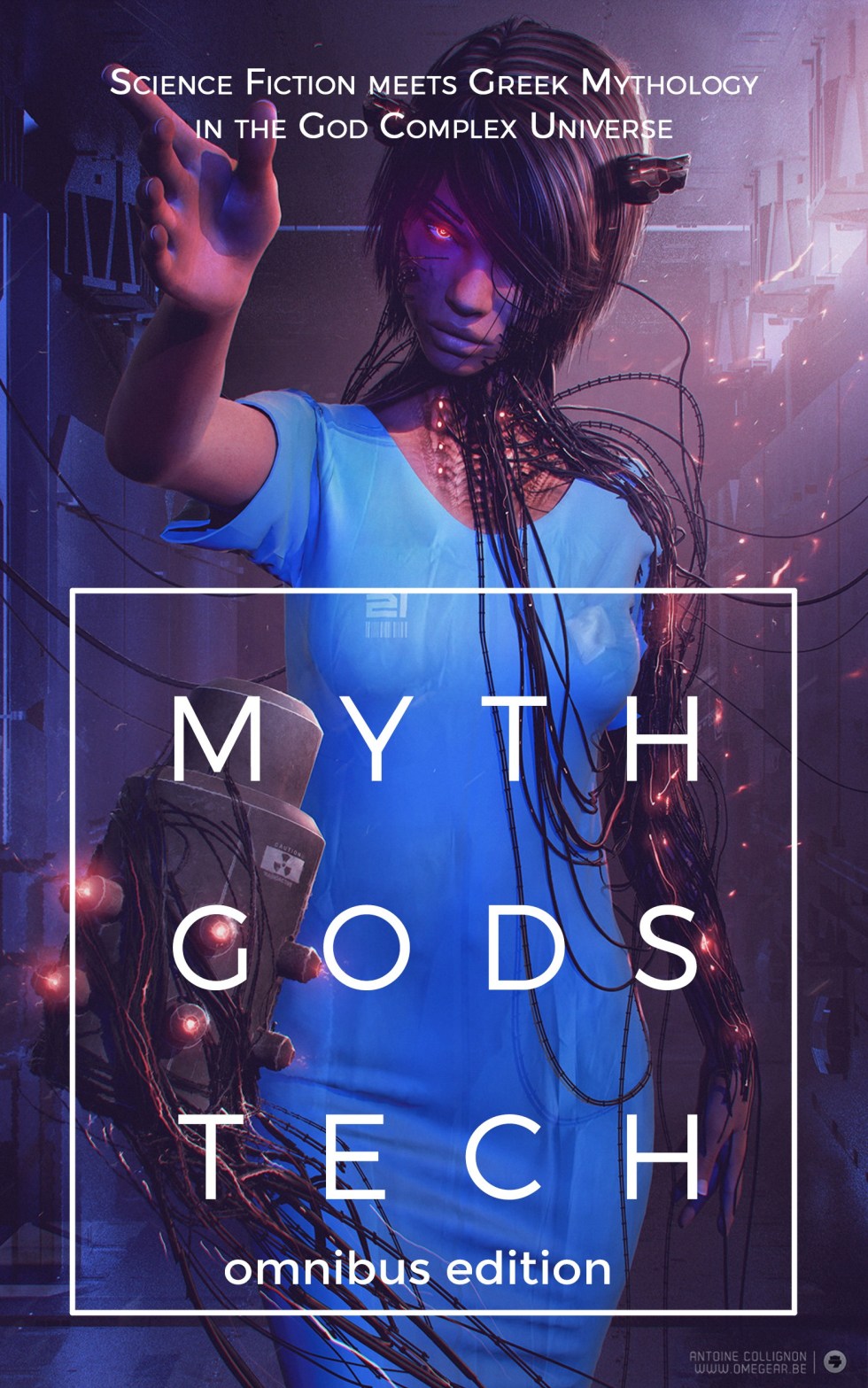
Myth Gods Tech is a constantly updated omnibus of all the books in the God Complex Universe.
Tell us how you like it! Vote on the poll:
Loading ...
There’s something different about this omnibus. We are constantly updating it with all the other books in the God Complex Universe. That’s correct, the omnibus is getting bigger all the time, updated with our new stories. There is a delay in the update (a few months). The price keeps going up, but everyone who purchased it early will keep getting the new files. If you haven’t already, turn on your DLC settings on Amazon so that the file is always up to date. On other retailers, just delete the file and redownload. If you happen to encounter any difficulty at all, just send us an email at [email protected] and we’ll sort it out.
That’s why this book is important, because it represents the whole body of work. But it also rewards dedicated fans like you, while being an experiment at the same time (We haven’t heard of any other publisher doing it).
Does this evoke the right feel for you? Please comment on this post, we want to hear from you.
This time we’ve really gone far and wide, making books available on ALL major retailers. There’s not a corner of the globe where one of them won’t reach.
We’ve got:
I mean, if someone had written that story in a novel somewhere, they’d have called it far-fetched. And this is real, it’s happening now.
Notice I didn’t say “a black man” on point 5. I said a person. Because that person was killed in front of a woman and a small child, and that just shouldn’t happen. But the dialogue on this is enormous, I don’t want to touch on that.
Yes, this photo is a chapter-break in our history. We have a full-scale dystopia posing as utopia, civil rights violated, technology both liberating and influencing ourselves, our minds, our decisions.
I worked a bit on a couple of news channels, and have a unique perspective on what things mass media want to show or not. I can’t actually write examples, but trust me on this: The media shows what it wants to. But you already knew that, deep down.
Also, with technologies like Live-U (multi carrier video broadcast from a mobile unit through any and all available cellphone companies) and Youtube, and Twitter and every person carrying a computer in his pocket, media has become more instantaneous. If the shot is there, the news channels will want it. A news crew carries top-of-the-line equipment worth easily 60-70 thousand euros, but if a kid on his iPhone got a better shot of the news-story, the news channel will broadcast the latter. Doesn’t matter if it’s shaky, doesn’t matter if it’s grainy, dark, out of focus. It will play, because it is valuable as news.
One day we had some faulty equipment and in our frenzy, we joked about having the weather guy just live-stream through Skype.
Then we got the go ahead, and we just put him through just like that. Fingers crossed and praying the line won’t drop.
Tor Publishing is running a cyberpunk week on their site. The very first post, It’s Not Fiction, It’s Our Lives, really struck a chord with me.
Artist’s rendering of the famous Ghost In The Shell opening. (Marek Okon)
A few decades ago the “cyberpunk” genre was purely fiction. Now, it is a reality that humanity struggles to navigate on a daily basis. Bodyhacking, information networks, megacorps… these concepts, borne from fiction, now shape our lives in very serious ways. And just as reality grows from forward-looking stories, so too does new fiction grow in response to the present day. What is a cyberpunk, or even “post-cyberpunk,” story when that is the world you live in?
That is prevalent in all our works, the idea that the future is now. Many of the things we do daily were considered science-fiction not so long ago. Access to information, anytime, anywhere? Real-time translation with augmented reality? Body-tracking, disposable drones, restaurant recommendations via an accurate algorithm? They’re all here, it’s not even shocking anymore.
In our exploration, three important aspects of cyberpunk become apparent:
Administration: Much of cyberpunk fiction drew inspiration from corporate structures that were only just beginning to solidify in the late 20th century, and what those stories extrapolated out towards isn’t too different from what we experience now in the early 21st century. Cyberpunk and post-cyberpunk fiction is uniquely suited to exploring the intricacies of the systems that govern us, whether those systems are controlled by corporations, governments, or the people themselves. Information is the currency of cyberpunk, and increasingly the currency of the present day. How can we use it to make something better? How should we use it?
Identity: Information technology is on the cusp of merging the biological and the mechanical into one seamless being, but what then does that being become? What is a person who can exist outside their body? Is there a purpose to gender and race classification? Especially when we are capable of creating programming that can think for itself, and does not require a gender or race? We live in an age where a person can fine-tune their appearance to a degree never before experienced, and cyberpunk fiction is at the forefront of imagining how a humanity consisting entirely of self-fashioned people works.
Culture and Commerce: We tell stories, regardless of form or circumstance, so what stories are told by those living in our world; a world imagined by cyberpunk fiction? What appeals to us?
The second point is well explored in science fiction, but I don’t like the political American debate on gender classification. Excuse me, but yes there is a biological reason for gender classification, it’s silly to presume otherwise. On race I agree, we’re all one species. Regarding the appearance, yes, I believe from the data points of body modification up till now, that it will become extreme. I truly believe that there will be people addicted to modifying their bodies, not cosmetically, like they do now, but with technology, horns, extra limbs and more unimaginable things.
Commerce seems to be the king. If something sells, the people behind it are willing to bend laws to their will, ignore morals, slave children to factories, fire family-men and replace them with robots, trademark common everyday words. There is literally no limit. Culture is slowly becoming one sloshy gray goo, with Asians celebrating Christmas (just because they like the holiday), American culture invading every other one with Hollywood and (apparently) superhero movies now. India is a strong counterpoint in this, spreading it’s culture all over the world but in a different light, it’s more of the same.
Anyway, this post isn’t meant to be a manifesto. These are just observations on the current state of things, plus some wishful thinking. Cause it’s not all bad. I recently had a conversation with some people of the earlier generation, and they claim that despite the Greek crisis here, we are still living relatively nice compared to the past. People didn’t used to have employee rights, air-conditioning or even shoes to wear.
There are medicines now for diseases that used to kill thousands. My father keeps a box of the pills that could have saved my grandfather on his desk. Just a stupid, tiny silly pill that if it had existed 50 years ago, my grandfather wouldn’t have to endure a lifetime of sickness and surgeries.
People can re-educate themselves in an open university if they like or through online courses. We have access to most of the books ever written with Project Gutenberg, and for the daily stuff, we have every shop we need just a short walk away. Mostly. Our cars are reliable, our homes are comfortable and travel is becoming faster and faster.
Corporations are making things nicer, easier and cheaper for us. But just because it helps with their sales.
We are running a promotion with other indie authors and publishing houses, all in Science Fiction and Fantasy genres.
Here Be Dragons
So, if you like sci-fi, fantasy and horror signup with your email address and get the May email that will give you an insane amount of 99 cent books to choose from! Yes I Want To Get An Email When The Promo Is Up!
This particular promo focuses on Spec-fic books on Amazon Kindle.
(Yes, the first ones are animated gifs. They are experiments with the digital format ) They are not necessarily books I’ve read or that I suggest, this is just a design thing.
The covers I picked are nice for various reasons, either typography, colors, composition or ideas. Some just work nicely in thumbnail size. They are the ones I browse for brainstorming. You can click the link or browse below:
I’ve happily stumbled upon this article on what Cyberpunk is and what will be. Which I will happily cannibalize for a few quotes on this post.
Cyberpunk does allow you to say a story of, perhaps Celebrity Singers and Biker Amazons 🙂 (credit Petri Rahkola)
It gets a bit academic, and I think the subject doesn’t need that much analysis but I like some of the points. I’ve even had a realization:
A kitsch self-parody
For all its outward cynicism, cyberpunk is often wilfully naive; conspiracies are unravelled, the lone maverick is redeemed, the lone aberration at the head of the system is taken out and all is well again. For all its gritty imagery, this dissonantly contradicts reality. Indeed it is questionable whether cyberpunk is an entirely dystopian genre. For the oligarch-villains occupying the luxury penthouses and boardrooms in which boss battles occur, this is utopia. The ubiquity of scaffolding in the genre’s platform games suggests there is even a building boom. It is a great time to be an engineer. Even for the average citizen, perhaps things aren’t that bad; there are plenty of exotic street-food outlets and sports to enjoy (you can follow the blood and chrome progress of Brutal Deluxe in the Bitmap Brothers’ 2007 Speedball series). Escape to off-world colonies, as we are told repeatedly by advertising neo-blimps, is an option for the rich and genetically sound. Some of the tyrannies are fairly relative. In X-Kaliber 2097 (1994), the reign of the warlord Raptor means “there are no more jobs to go to,” echoing the current fear that automation might render us all unemployable. “Well,” we might say, “thank god for that.” Even when the apocalypse beckons or has already happened (the release of the planet-decimating biochemical Lucifer-Alpha in 1988’s Snatcher, for example), it is survivable.
I like that. Yes, deep down cyberpunk is wish fulfillment, does have a happy ending, the corporations do lose. Vices are plentiful, humanity has far-out options for life extension and survival, heroes are cool and larger-than-life.
My kind of cyberpunk is rather light. All the tropes are there, but they are a backdrop to character and plot. Mega corporations crush people and effectively become worshiped, but we see the casual interactions and the family issues. Not the sweeping socio-economic ones, which frankly, would make a boring read.
Following the maxim of its baptist William Gibson that “the future is already here, it’s just not evenly distributed,” cyberpunk has always been a scrapyard, with pieces of what is to come scattered through the past and present. Indeed, its saving grace is that it recognizes, as other futurology often fails to, that the future will be a collage and it will be considerably older than the present.
That scrapyard is what I try to put in my own stories. A bit of Greek mythology, a bit of plausible technology, a narrative that draws you in, and some action to keep it exciting. Because, make no mistake, violence is at the cybernetic heart of cyberpunk.
The fear and power of plugging in and losing our humanity in the process, continually evident in cyberpunk, is again not new; we find precedents in Descartes’ Demon and Plato’s Cave. There is also a certain guilty pleasure in immersing yourself in a videogame world that warns you of the dangers of immersing yourself in videogame worlds. The early game Interphase (1989), by The Assembly Line, deftly equates virtual reality with dream-space, a crossover we will no doubt increasingly see with advances in VR, AI and augmented reality. At that time such developments seemed the stuff of dreams, but they are incrementally becoming more real. In Ubisoft’s Watch Dogs (2014), the hacking abilities of the lead character Aiden Pearce suggest that the human brain, the city and cyberspace are now interwoven networks. To accumulate great power in the latter two is to potentially wield power over the first.
My main issue with VR is that one. I too have been brought up with Neuromancer, and Matrix more recently (yes I said recently, shuddup), but I don’t think VR is what we thought it would become in those days. I firmly believe, that instead of diving inside the computer world, we will superimpose the digital word over the physical one. A Shared Augmented Reality, giving us information and allowing us to interact with the digital equivalent of the physical objects. In my works, I call it the veil, a shared overlay of public data. For example, when people look at you with SAR glasses or maybe someday contact lenses, they’ll see your public facebook and twitter profile, all available for interaction.
When the daughter of Greece’s premier singer fails to sing as expected, she finds out about a biker group of women. But will she manage to find the elusive Orosa, the bikers’ motovlogger, when all she has to go on are random street-sightings of criminal behaviour, when her family is opposed to her following this path and when her dad’s employer wants to keep her as she was for marketing purposes?
Do you want to know what’s next for the voiceless Aura? Do you wanna meet the Amazons? Then read this coming of age story in a world where fate is quite literal.
Wattpad has done us the honor of featuring the Muse story on the Science Fiction category.
Call Now!
On the verge of abandoning his life-long project, an obsessive physicist hires the innovative service of an android Muse to help him finish his work. But when things start to go missing from his life, he must learn that not all is worth sacrificing on the altar of science before he has nothing left to live for.
Do you want to know what’s next for poor-but-brilliant Yanni? Do you wanna meet the Muse? Then read this unique sci-fi thriller that toys with the very concept of inspiration.
Promotion over! But you can signup at the mailing list through the big button below and get notified on future special offers.
We are running a promotion with other indie authors and publishing houses, all in the speculative fiction genre.
Lets clog those Kindles!
So, if you like sci-fi, fantasy and horror signup with your email address and get the April email that will give you an insane amount of free books to choose from! Yes I Want To Get An Email When The Promo Is Up!
This particular promo focuses on Spec-fic books on Amazon Kindle.


 Loading ...


